Puerto Rico
CaribbeanTerritory
Drag to pan · scroll to zoom · click a country to open it
About
Puerto Rico, officially the Commonwealth of Puerto Rico, is a self-governing Caribbean archipelago and island organized as an unincorporated territory of the United States under the designation of commonwealth. Located about 1,000 miles (1,600 km) southeast of Miami, Florida, between the Dominican Republic in the Greater Antilles and the U.S. Virgin Islands in the Lesser Antilles, it consists of the eponymous main island and numerous smaller islands, including Vieques, Culebra, and Mona. With approximately 3.2 million people, it is divided into 78 municipalities, of which the most populous is the capital municipality of San Juan, followed by those within the San Juan metropolitan area. Spanish and English are the official languages of the government, though Spanish predominates.
Read more on Wikipedia →The Flag
History
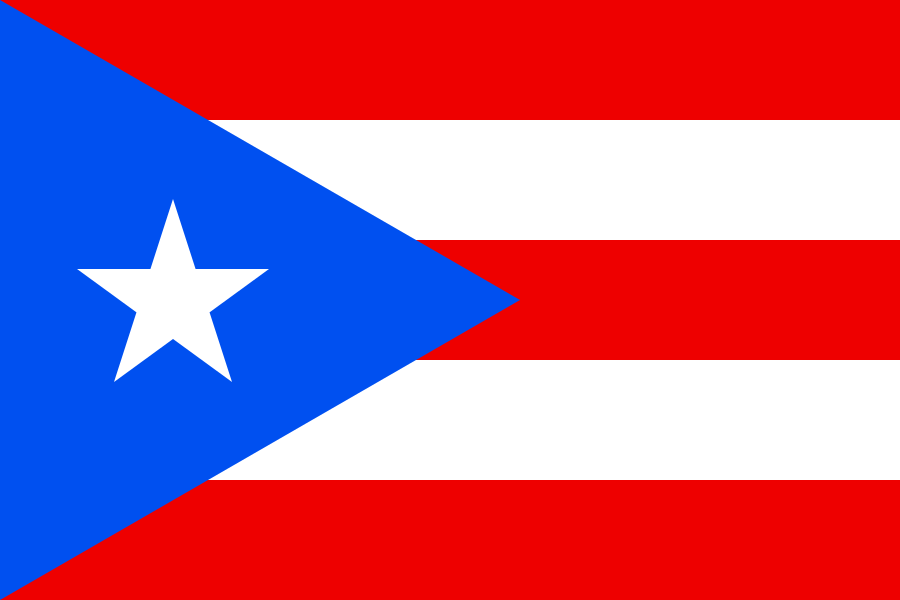
The flag of Puerto Rico, officially the Flag of the Commonwealth of Puerto Rico, represents Puerto Rico and its people. It consists of five equal horizontal stripes, alternating from red to white, with a blue equilateral triangle based on the hoist side bearing a large, sharp, upright, five-pointed white star in the center. The white star stands for the archipelago and island, the three sides of the triangle for the three branches of the government, the blue for the sky and coastal waters, the red for the blood shed by warriors, and the white for liberty, victory, and peace. The flag is popularly known as the Monoestrellada (Monostarred), meaning having one star, a single star, or a lone star. It is in the Stars and Stripes flag family.
Design & symbolism
The introduction of a flag in Puerto Rico can be traced back to November 19, 1493, when Christopher Columbus landed on the western shores of the main island, and with the flag appointed to him by the Spanish Crown, claimed the island in the name of Spain, calling it San Juan Bautista (Saint John Baptist) in honor of prophet John the Baptist, who baptized Jesus Christ. Columbus wrote in his logbook that on 12 October 1492 his fleet carried the royal standard of the Crown of Castile, representing the Spanish Monarchy, and La Capitana ("the captain"), the expeditionary ensign of the explorer, which featured, on a white background, a green cross in the center and a green 'F' and 'Y' crowned with golden, open royal crowns for Ferdinand II of Aragon and Ysabella I of Castille, the Catholic Monarchs of a unified Spain. Conquistadores under the command of Juan Ponce de León, the first European explorer and governor of Puerto Rico, proceeded to conquer and settle the island in 1508, displacing, enslaving, and killing the native Taíno people. They carried the royal standard of the Crown of Castile, the emblem representing the Spanish Monarchy, and the Cross of Burgundy, the military…
Looks like
Flags often confused with this one — tap one to compare side by side.
Photos