São Tomé and Príncipe
Middle Africa
Drag to pan · scroll to zoom · click a country to open it
About
São Tomé and Príncipe, officially the Democratic Republic of Sao Tome and Principe, is an island country in the Gulf of Guinea, off the western equatorial coast of Central Africa. It consists of two archipelagos around the two main islands of São Tomé and Príncipe, about 81 nautical miles apart and about 135 and 121 nautical miles off the northwestern coast of Gabon. With a population of 201,800, São Tomé and Príncipe is the second-smallest and second-least populous African sovereign state after Seychelles.
Read more on Wikipedia →The Flag
History
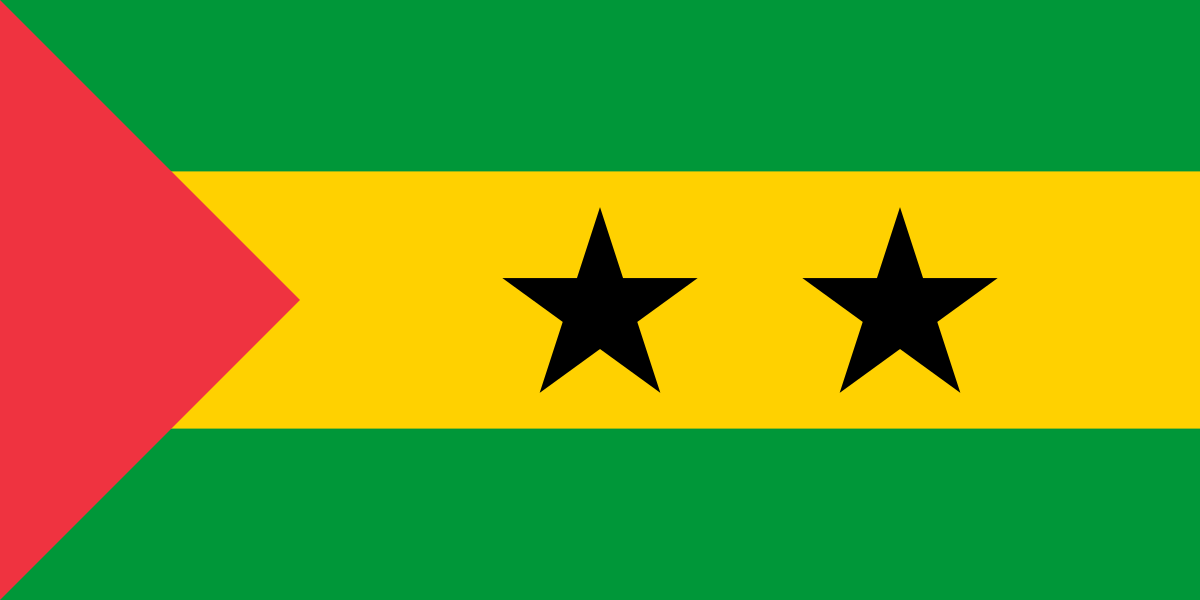
The national flag of São Tomé and Príncipe is a horizontal triband of green, yellow, and green, with a red isosceles triangle at the hoist and two five-pointed black stars on the yellow band. The flag's aspect ratio is 1:2 and the ratio of the bands are 2:3:2. The flag was adopted upon São Tomé and Príncipe's independence from Portugal on 12 July 1975. The design is based on, and nearly identical to, the first flag of the Movement for the Liberation of São Tomé and Príncipe (MLSTP), which led the country to its independence.
Design & symbolism
The flag was designed by Manuel Pinto da Costa, the first president of São Tomé and Príncipe. It is almost identical to the MLSTP flag except that the widths of its bands are at a ratio of 2:3:2, while on the MLSTP flag they are equal. The flag's colours are shared by the flags initially adopted by two other former Portuguese colonies, Cape Verde and Guinea-Bissau, and all three feature a black star. The colours and symbols of the flag carry cultural and political significance; however, sources differ on the specific meanings. The office of the São Toméan president gives the following significance to the flag's elements: green, yellow, and red are the Pan-African colours and represent the São Toméan independence movement; the triangle represents equality; and the two black stars represent the country's two eponymous islands, São Tomé and Príncipe. American vexillologist Whitney Smith attributes additional meaning to the flag; according to him, green represents the islands' lush vegetation, yellow represents the tropical sun, the red triangle represents equality and the independence movement, and the two black stars specifically represent the African population of the two islands.…
Photos


