Papua New Guinea
Melanesia
Drag to pan · scroll to zoom · click a country to open it
About
Papua New Guinea (PNG), officially the Independent State of Papua New Guinea, is an island country in Oceania that comprises the eastern half of the island of New Guinea and offshore islands in Melanesia, a region of the southwestern Pacific Ocean north of Australia. It has a land border with Indonesia to the west and maritime borders with Australia to the south and the Solomon Islands to the east. Its capital is Port Moresby. The country's 462,840 km2 (178,700 mi2) includes a large mainland and hundreds of islands.
Read more on Wikipedia →The Flag
History
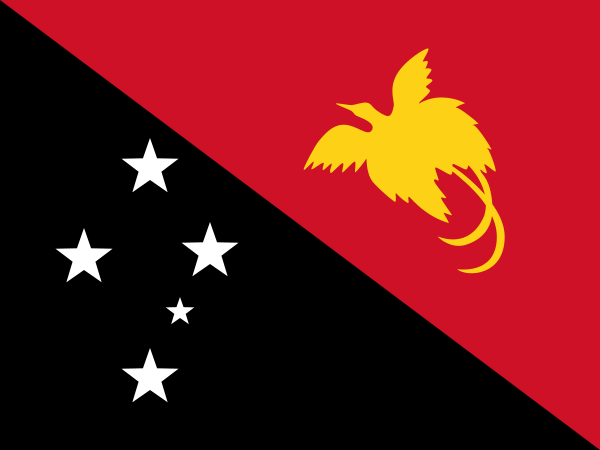
The flag of Papua New Guinea was adopted on 1 July 1971. In the hoist, it depicts the Southern Cross; in the fly, a Raggiana bird-of-paradise is silhouetted.
Design & symbolism
The design of the Papuan flag is divided in half diagonally from the top left (upper hoist) corner to the bottom right (lower fly) corner. The upper triangle is red with a Raggiana bird-of-paradise in gold yellow and the lower triangle is black with five white stars forming the shape of the Southern Cross. Red, black and yellow are traditionally used as colours to represent Papua New Guinea, and black white and red were the colours used in the flag of the German Empire, which colonised Papua New Guinea in the 19th century. The bird of paradise is a symbol of tribal culture in Papua New Guinea, and its soaring position represents the nation's emergence. The Southern Cross, meanwhile, signifies their relationship with other nearby countries in the southern hemisphere, and the flags of Australia and New Zealand feature the cross as well. According to the "Rules Respecting the Use of the National Flag and the National Emblem", the flag should be displayed as follows: (b) On a halyard–the Bird of Paradise to be uppermost, and the flag hoisted as closely as possible to the block with the halyard taut. (c) Flat against a wall–the Bird of Paradise to be in the upper right-hand corner…
Photos


