Angola
Middle Africa
Drag to pan · scroll to zoom · click a country to open it
About
Angola, officially the Republic of Angola, is a country on the western coast of Southern Africa. It is the second-largest Portuguese-speaking (Lusophone) country after Brazil in both total area and population and is the seventh-largest country in Africa. It is bordered by Namibia to the south, the Democratic Republic of the Congo to the north, Zambia to the east, and the Atlantic Ocean to the west. Angola has an exclave province, the province of Cabinda, that borders the Republic of the Congo and the Democratic Republic of the Congo. The capital and most populous city is Luanda.
Read more on Wikipedia →The Flag
History
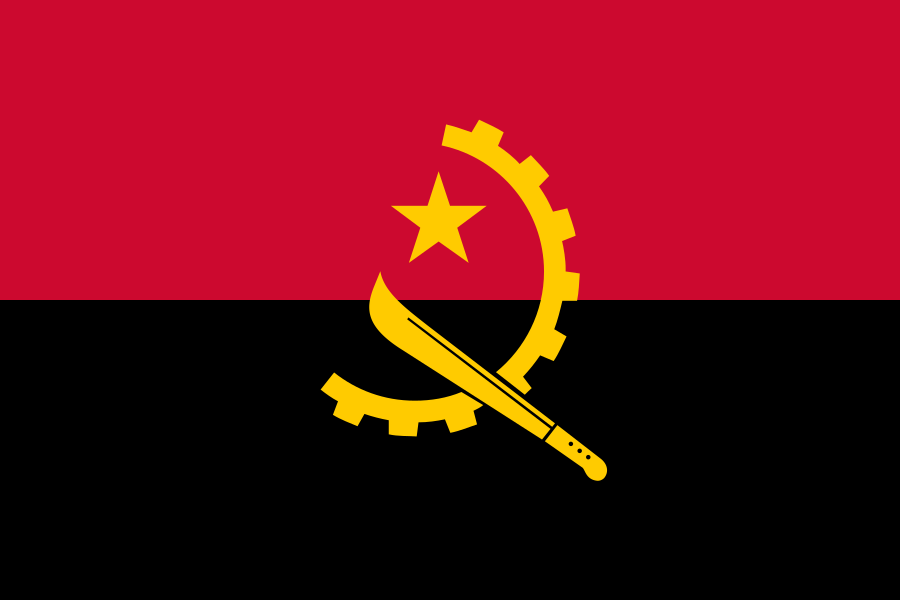
The national flag of Angola is a horizontal bicolour of red and black, charged in the center with a yellow emblem consisting of a machete crossed by a half-cogwheel and crowned with a five-pointed star. It was adopted on 11 November 1975, when Angola became independent from Portugal following the thirteen-year Angolan War of Independence. The original meanings of the flag's colours and symbols accordingly referenced the war and colonial period, but they have since been reinterpreted to represent the Angolan people and society more broadly.
Design & symbolism
Annex I of the Angolan constitution outlines the design of the flag and gives its colours and symbols significance. The flag is a horizontal bicolour consisting of a red upper band and a black lower band. Black represents Africa, while red represents the blood shed by Angolans during the colonial period, the war of independence and in defence of the country. The flag is charged in the center with a machete crossed by a half-cogwheel and crowned with a five-pointed star. The machete represents peasants, agriculture, and the war of independence; the half-cogwheel represents workers and industry; and the star represents international solidarity and progress. The charge is yellow, which symbolises the wealth of Angola. In the original constitution of 1975, "defence of the country" was "revolution", and "international solidarity" was "internationalism". American vexillologist Whitney Smith notes that the Angolan flag's charge is similar to the star, hammer and sickle of the Soviet flag. Parameters in which the flag should be constructed are specified in section 2.1 of the Angolan government's manual of graphic and protocol standards for national symbols. The position and size of the…
Photos


